
Our Parish
The Parish is comprised of the people and churches of St Matthew’s, Mitchelton and All Saints, Arana Hills
Brief History of St Matthew’s
Based on information from: Grovely, Grovely, Grovely by Isobel Nicholson (1984)
and The First 100 Years of the Little Church on the Hill by Philip Chamberlain (1967)
In 1864, John and Mary Nicholson, their two-year-old daughter Frances Mary, and John’s brother, William, migrated to Australia, landing in Melbourne and later continuing their journey to Brisbane.
John and Mary bought land in Church Road in 1864 and Grovely Lodge was erected on this property. William married Elizabeth Kearney and lived on a nearby property.
On completion of Grovely Lodge, John and Mary began holding regular public worship in the large room in the Lodge and John undertook to conduct services according to the rites of the Church of England. The service was Evensong, and Mary supplied the music and conducted a Sunday School.
In 1866, Rev’d Edward Tanner conducted Evensong at Grovely Lodge which he called “the little church in the wilderness” before leaving for his new appointment as Rector of Mackay. Prior to this visit, the Rev’d James Matthews of Holy Trinity, Fortitude Valley had conducted services at the Lodge.
When it was decided by the settlers that they should have a church of their own, the Nicholson brothers readily permitted the erection of the church on their property, on the condition that the grounds remained in their possession.
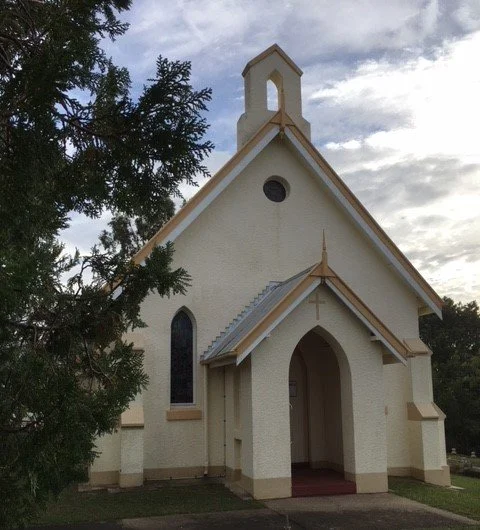
Mr Tiffin, the Colonial Architect, was asked to plan the church, based to some extend on the design of the church at Barford—St Martin’s, Wiltshire, England. Photographs of St Martin’s hang in St Matthew’s. There has been some question as to whether the design was based on that of St Martin’s or whether it is that of the Chapel in Grovely Wood.
Many of the settlers gave of their time to the building of the church; others gave gifts and materials. Pews were made at Red Hill from cedar trees cut on Samford Station. Baked bricks of clay and straw were made by German labourers at pits near Elworthy Street and Grovely Terrace, Mitchelton.
The setting of the Foundation Stone by Sir George Ferguson Bowen, the first Governor of Queensland, took place on 23rd of September 1867. Clergy present were:
Rev’d Thomas Jones, St John’s, George Street
Rev’d James Matthews, Holy Trinity, Fortitude Valley
Rev’d Henry Jepson Campbell, St Mary’s, Kangaroo Point,
Rev’d Joshua Jones
Many Aboriginal people were among the 300 or so assembled for the occasion.
Rev’d Thomas Jones conducted the first service on Wednesday, 7 February 1869, at 3 pm. After the service he baptised John Christopher Nicholson, Arthur Marshall, and Hannah Pickering.
Rev’d John Sutton, assisted by Rev’d Thomas Jones (both of St John’s, George Street), conducted the first marriage service. The bride was Mary Isabella Robinson, a Sunday School teacher born in Chile, and the groom was Robert Morgan, a farmer from Oxley Creek. The wedding was registered at St John’s.
The first funeral, that of John MacDowall, aged 19, was conducted by Rev’d J Matthews on 19 February, 1869. The McDowall family plot is to the right of the Lych Gate as you enter the grounds.
A bottle containing the names of those who had regularly attended services at Grovely Lodge together with a copy of the Governor’s speech was placed under the Foundation Stone. As it was not then the custom to mark the location of this stone, its whereabouts is not known.
In 1914, the bell now in use was presented by Howard S. Bliss and erected on the bell post. The previous bell which John Nicholson had purchased from the Water Board had been mislaid. It appears the bell turret was unsatisfactory and the bell was removed. All trace of it has been lost.
The Hall was built for the 50th Anniversary in 1917 and the Rectory in 1926. Grovely became a Parochial District in 1920 but the Parish of Grovely was not established until December 1947. St Matthew’s is still the Parish Church.
The Nicholsons established what was essentially a mission station at Mitchelton. The nearest church was All Saints, Wickham Terrace and the population of what we now call Brisbane was only about 5,000.
Bishop Tufnell refused to license St Matthew’s as a place of worship until certain conditions were met. Such was the impasse, that St Matthew’s has never been formally consecrated. Because St Matthew’s was not a licensed place to worship, the first wedding, alluded to above, was recorded having taken place at St John’s, George Street. The wedding was registered at St John’s because that is where the clergyman who officiated came from; there was no clergyman at Grovely. This was customary. However, it is clear from Mary Nicholson’s correspondence that it was celebrated at St Matthew’s.
John and Mary Nicholson died in the early part of the 20th century and are buried in the grounds of St Matthew’s. Many of those present at the laying of the Foundation Stone are also there, as are many of their descendants.
Worship services still continue today in the heritage listed St Matthew’s.
Brief History of All Saints’
The Rector, Father Keith Colbert (1975 – 2005), was keen to have a new church and when the St William’s Catholic Church decided in 1983 to sell the land they owned in Cobbity Crescent as it was surplus to their needs, the rector urged the parish council to buy it as a site for a new church.
A lot of thought then had to go into the reorganisation of the parish. It was put to a general meeting of the parish that All Souls’ which had a small congregation would have to be sold when the new church was built to reduce the number of Sunday services. There was much heartache at this proposal but by the end of the meeting this had been agreed to. It was decided that as a symbol of solidarity, the congregation from St Peter’s would move to All Souls, in the hope that a similar move from there to Arana Hills would be made when the new church was built.
The last service at St Peter’s was held on 25 January, 1987, with the congregation (the following week) moving to All Souls for services.
The Rector and churchwardens inspected many church buildings in Brisbane and a letter was sent to architect Eric Parups in February, 1989 requesting him to submit ideas and plans for a building in Cobbity Crescent.
On 7 October, 1990, Bishop George Browning turned the first sod on the land at Cobbity Crescent.
In July 1991, an offer of $200,000 was received for All Souls’ and accepted by the Diocesan Registrar.
A lot of preparation had to be done on the land at Cobbity Crescent before building could commence but at last the work got under way. Parish Council held long discussions on the furnishings. The Archbishop preferred a piano rather than an organ and luckily the Rector knew someone who had a grand piano and nowhere to put it.
One of the most contentious issues was the matter of seating - would there be pews, or separate chairs, or groups of chairs attached together. In the end it came down to a matter of finance and it was decided that the pews from All Souls’ would have to be used. The biggest problem with this was that they had been made in different sizes to fit that church but with a little thought they fitted into the new church. These pews had all been given in memory of family or friends of the congregation of All Souls’ and they were asked if they would like to keep the memorial plates from the pews. Some did, but most were left on the pews in the new church.
A name for the new church was discussed and while many would have liked to keep the name of St Peter’s, it was decided to that the new church would be called All Saints to indicate the coming together of the whole parish, in memory of St Peter's, All Souls and St Matthews congregations.
Items for a time capsule to be placed in the wall were also collected but this never eventuated.
Once again, the parish was faced with a large debt and fundraising became urgent. Later, a general meeting of the parish was again called and it was decided to sell land at Upper Kedron which had been given to be held in trust for St Matthew’s parish. This took some time but by 2000, All Saints’ was debt free and able to be consecrated.
On 7 May 2000, the church was consecrated by Archbishop Peter Hollingworth.